
What Fascia and My MSW Journey Taught Me About Healing Systems and Communities
Imagine a web or safety net beneath the body’s surface, holding everything together, barely noticeable, but its function vital to how you move throughout your changing environments. If you’ve ever been told that everything in the body is connected, the fascia makes this statement an infallible truth.
SOCIOPOLITICAL
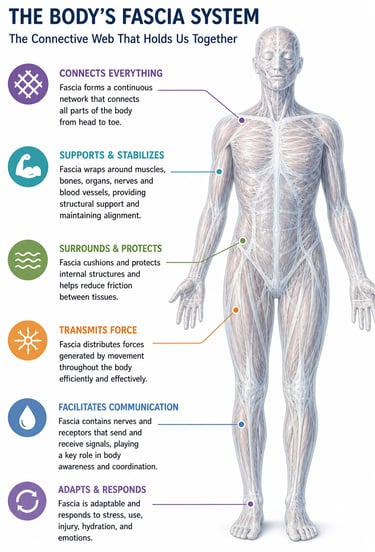
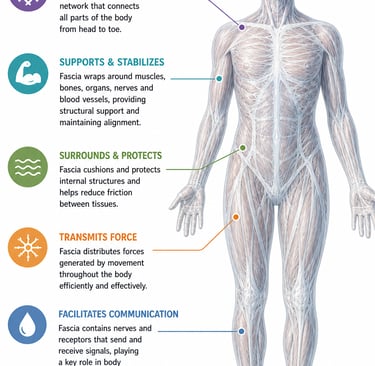
Brown University Health defines fascia as a continuous, thin, and dense web of collagen connective tissue that wraps every muscle, bone, nerve, and organ, acting as the body's structural, sensory, and protective, three-dimensional matrix. It enables smooth movement, transmits force, and plays a significant role in proprioception. How marvelous this intelligent layer of connective tissue that if it ever were to become restricted, one could only then imagine how impacted a person’s journey might become. The same is true for overly restricted systems of care that often fail those that depend on it. The fascia is like our body’s integrated care network, though it doesn’t do the heavy lifting, it helps us navigate, or regulate, the central nervous system. So how do we restore flow back to the system?
The Old Paradigm
Before I was more informed, I was a victim of improper stretching and even as a collegiate runner, and arguably the best physical shape of my life, I still could not overcome the burden of stress injuries. These injuries were caused by overuse and incongruent recovery methods, but the underlying trigger was body mechanics. Over time the body learns to adapt to your lifestyle, shutting off muscles that don’t get used as often and prioritizing those that do. Stretching or forcing muscles to unrestrict themselves only leads to further injury, damaging to the identity, mood, and self-esteem. For years, people can carry these burdens, manifesting as trauma in the body without a single trace, unrecognized and undiagnosed. All attempts to explain these symptoms get covered in labels until you become something you were never meant to be.
Those who carry such trauma have to develop a tougher skin, but years of neglect and repeated conditioning wears the body down, and without a good safety net, vulnerabilities are exposed and anyone could fall through our societal cracks. But no one builds endurance by giving up. We fight through, we seek help, but the fascia is silent and so are the systems that support us. Loud are the neighborhood Karens, nimbyism stale on their breath. They do not recognize that what they perceive as fault is a form of coping, unable to heal probably because they are unheal also, but with better safety nets in place. To be fair systems move slow and people don’t always respond the way you expect, and this leads to frustration and sometimes burnout without proper coaching or support. Forcing anything will never be the best solution, yet that is the default for many of us, relying on reserves of will power that was intended for far more passionate pursuits. Whether in tissue or in people, we see that force creates resistance.
The Fallen Angel
During my practicum in the specialist year of the MSW program, I worked with a client who jumped off a building at 18 years old. Her injuries left her with a broken back and a traumatic brain injury that impaired her speech. Our interactions were rocky, the type of dynamic where you say, “you couldn’t pay me enough”, yet she was a very capable person despite living most of her life on social assistance programs as life support. During one of our sessions she uttered the words, “learned helplessness”, acknowledging her decompensating condition and a sign that she has accepted this new identity. I could only imagine the emotional weight she carried without a proper way to release or express the frustration she feels about the system that fails her daily.
I began to see my own communication failures in her frustrations. How short her fuse was and the torment she acted on those she felt could not understand her. The ugly truth is that no one wants to be around this kind of person. We all work on bettering ourselves and I’ve observed that trauma can be transferred through bonding, through the media we consume and the company we keep. What we consistently hear we then start to believe and with no pathway forward, the stagnation this causes further distances us from true self-determination. The greater reason why this case is significant is because I could physically see the restrictions in her body and how that translated to her self-efficacy, her dependencies, her resilience, and the faulty systems that she survived on.


Becoming the Vehicle, Not the Driver
As I mentioned earlier, the fascia system does not respond to force. It requires us to be patient and listen to our bodies, then only when we’ve completely understood can we do exactly what the body says it needs. Relinquishing control brings about a transformation that takes us out of the driver seat, and in doing so, something special also happens…we do nothing. We realize that we’ve put way too much responsibility on ourselves to come up with solutions to fix the problem instead of allowing the problem to fix itself. I’ve seen this with clients who believe that quick fixes are the solution to their desired outcomes, and though they help to reframe identity for a short period of time, the underlying system keeps them socially ostracized because they only seek to appear normal on the surface. The real work takes patience to reconstruct the road in which the vehicle must travel. That work must come from within.
As social workers we must hold space instead of directing clients to fit into the boxes that exist for them, but the reality is we are quota driven and state funding flows through data reported by a workforce asked to separate empathy from the economics. As a soon to be MSW graduate, I
learned that social work was never meant to heal, it was designed to develop a surplus workforce to provide assistance to vulnerable populations in their environment - a more humane alternative to institutionalization. In the past I was proud to take on such titles as leader, problem solver, and decision maker, but now this paradigm is outdated to me. I still respect the qualities of these types of individuals, but not without considering what it means to facilitate, to reflect, and to connect. There is a necessary balance between them that truly cements exemplary community advocacy.
Just One More Advocate
Another client of mine taught me the power of advocacy. I observed how he felt so at peace with all of his care team surrounding him, making him feel heard. I almost was as if they were speaking for him…because they were. His biggest advocate was just a good friend, there to make sure his needs were being met. The caseload of a case manager is heavy work and sometimes that gets overlooked, yet having a good advocate pushes your case to the front of the pile. They keep everyone accountable for their actions, what they say they will do, and can amplify certain emotions that the client is feeling.
The world of social work has rules and it has players. Having an advocate is the best kind of player to have on a care team because they bridge gaps in care and are especially beneficial to the care continuum. With just one advocate an individual is no longer alone and together they can build momentum for service needs. His advocate would eventually apologize for pestering, but with proper intent and purpose there is nothing to apologize for.
Returning to Flow
If fascia teaches us anything, it’s that healing is not about force, it’s about restoring connection. Over the last two years, my journey through this MSW program has mirrored that truth. I entered believing that impact came from doing more, pushing harder, and solving faster. I leave understanding that this was defective thinking. Real healing requires patience, presence, and trust in the body’s, and the community’s, ability to recalibrate when given the right conditions.
I’ve learned that I am not responsible for carrying the weight of every outcome. I am responsible for how I show up. To listen more deeply. To create space instead of filling it. To recognize that what looks like resistance is often protection, and what looks like stagnation is often a system waiting for the right kind of support to move again. In that way, healing others has become inseparable from healing myself. The same tendencies I once brought into my work were also present in how I moved through my own life. Releasing them has allowed me to find a different kind of strength, one rooted in alignment.
As I look ahead, this mindset travels with me into my next chapter - an exchange program in Australia. It is more than an academic opportunity; it is an extension of my commitment to remain curious, to learn across cultures, and to expand my understanding of how communities heal themselves in different environments. While licensure remains my goal, what I seek is interdisciplinary growth, the tools that bridge mental health, culture, movement, and creative expression to build stronger, more connected communities


Because if fascia is the system that holds the body together, then community is what holds us all. We don’t just help people function, we help them flow.